
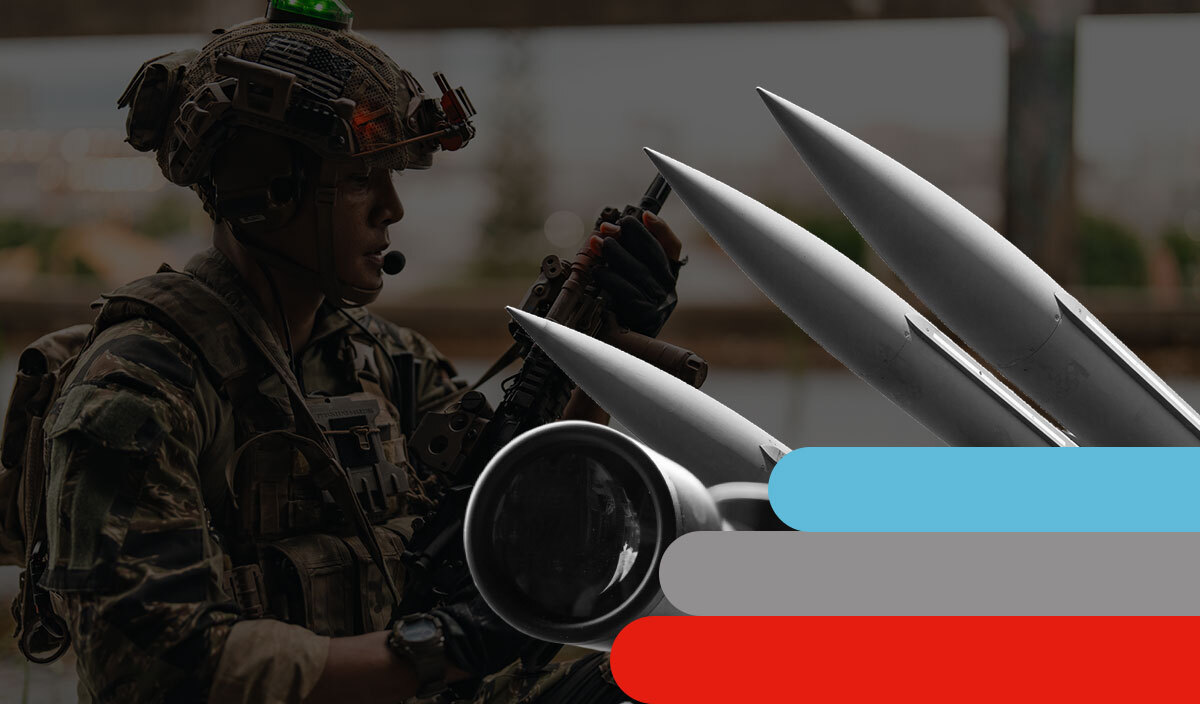
How McDanel Advanced Materials works with the United States defense industry to supply components in technical ceramics, precision glass, and optical windows.
One of the challenges of working in advanced materials is explaining what it is we manufacture and where it can be used. Our materials have a wide range of potential applications, but most of our work is highly custom, and the end products so unique that even describing them could reveal protected information.
At the same time, we commonly have customers come to us and say: “we need to accomplish X objective, but we don’t know where to start.” They may be dealing with a novel engineering challenge, a quality concern with another supplier, or a sticky issue in their assembly process that they’re tired of working around. We may discover that the solution is to use sapphire instead of fused silica, to introduce a new component to the slurry compound, or to redesign an assembly with a different step.
It’s rare for us to encounter a problem we can’t solve. But to get to that point, our customers need to understand that we can help them. And for that, they need to understand what we can do.
In the commercial sector, we have over one hundred components in use on the Airbus A380. Our defenses customers use us in hot engine sections, such as turbo flameout areas, as well as in certain missile models and in drones. We also manufacture alumina discs in hydrophone assemblies for submarines. This article explores in more detail McDanel’s capabilities across our three advanced material divisions.
Technical Ceramics for Defense
Defense customers in our ceramics division are driven by a need for smaller, lighter, and more intricate parts. Technical ceramics have special properties, including their heat resistance, ability to withstand oxidization, and excellent electrical properties, that give them an advantage over other materials in some applications.
McDanel Advanced Ceramics (MAC) offers several specialized skills in this field which differentiate us from other suppliers. These include:
- Isopressing. We are able to press parts into a very tight, near-net shape, which lowers costs by reducing the amount of machining required after firing. Designs for isopressed parts can also be much more intricate than for parts that are extruded or cast.
- Grade of alumina. We offer fine-grained alumina between 96% to over 99.9% purity depending on the application. The fineness of the alumina powder combined with these exceptional purity levels confer key advantages to our parts, including extremely high hardness, flexural strength, dielectric strength, corrosion resistance, and thermal shock resistance, as well as imparting a smooth surface finish that can be coated or metallized if needed.
- Custom compounds. Because we start with base ceramic powders to form the base slurries for our parts, we can adjust our formulas by incorporating other components to add desired characteristics. Our engineering team is ready to work with our customers to meet any demanding application.
Precision Glass for Defense
Our glass division, McDanel Glass Solutions (MGS, formerly Richland Glass) specializes in hermetic work. Our most common use case is for feedthroughs, which are sealed to allow electrical wiring to pass through a vacuumed or pressurized space without leaking any gas or liquid.
We also work with flameout detectors, which use a hermetic seal to protect the sensors that confirm whether a jet engine’s afterburner is lit. This is an essential safety component for defense aircraft, as it prevents fuel from collecting within the engine and igniting unexpectedly.
One of our more unusual applications is for onion skin glass, which is used for military grade glowsticks. The super thin glass holds a chemical which, once released, creates a luminescent reaction. While this is a niche use case, it highlights our ability to produce incredibly thin glass.
Optical Windows for Defense
Like our glass division, McDanel Optical Technologies (MOT, formerly Rayotek Scientific) also specializes in fusing technology. Our windows are not only hermetically sealed, they are highly pressure resistant so that they form a tighter seal under impact. We have even developed testing methods for our products that have been approved by NASA.
Uses for our optical technologies have included:
- Fused Silica for the B2 bomber. These sit on the wing of the plane and protect the navigation instrumentation underneath. In the event of a nuclear event, this instrumentation would be used to navigate by constellations.
- A mirror on the KC46 Pegasus refueling jet. In the original design, the operator would need to lean over the side of the plane to direct a refueling boom. We have built a mirror with electronics behind it that allows the operator to guide the boom using a vision system and joysticks so that refueling missions can happen in all weather conditions, day or night. The finishing process on the mirror requires highly precise lapping and polishing techniques which are another of our key differentiators.
- Vision systems for drones. We develop components which protect those sensing systems on the drones which are responsible for locating, locking on, and eliminating the target.
- Diffusers used in missile assemblies. These are optical discs which redirect and diffuse lasers toward a desired angle and which are used as part of missile systems.
- Windows on the Orion space capsule supporting NASA’s Artemis Space Program. One of our innovations on this project was to switch from fused silica to acrylic to create a lighter window that could still withstand the vacuum of deep space and the heat and friction of reentry while remaining crystal clear. This project combined our core capabilities—advanced material expertise, hermetic sealing, specialized testing, and custom processes for polishing and microfracture repair—to deliver an exceptional product. The images of Earth which were sent back from within the Orion capsule were captured through McDanel optical windows.
The McDanel Difference: Work with Us, Engineer-to-Engineer.
We are an engineering company to our core. While other players in the field want to operate bigger, longer runs, we are more excited by smaller projects that allow us to fine-tune the details and experiment with more challenging use cases. Our facilities are equipped to work through prototypes as the first step in developing a production protocol, or on one-of-a-kind parts for hyperspecialized applications.
We’ve also solved entirely new engineering challenges of the type that only emerge in the most extreme environments. Currently, our optical technologies division is working with NASA on the DAVINCI probe, which will be entering the atmosphere of Venus and descending to the surface of the planet. The probe will carry sensitive equipment used to test superheated noble gasses in the intense pressure of Venus’s atmosphere, as well as cameras to take pictures of the Venusian surface. Both the equipment and the cameras will be protected by McDanel optical windows.
If you are searching for experts in advanced materials to help you tackle an engineering challenge, contact us today. We will talk with you engineer to engineer to understand your requirements and codevelop a solution. Our team is ITAR registered, AS 9100 certified, and fully prepared to get to work.


